+375 29 34 37 358
 +375 33 34 37 368








 !
! !
!




Everyone has probably already heard, and more than once, about such a bed attribute as a sheet with an elastic band. Someone, wanting to get all the benefits from using it, goes to buy it in bed linen store, and someone thinks about how to sew a pillowcase, a duvet cover or a stretch sheet with your own hands.
There is a lot of information on this topic on the Internet. All of it is presented in a different form, which is sometimes difficult to perceive, both visually and informatively.
We will try step by step, in an illustrated form, to convey information about the easiest way to sew a sheet with an elastic band, from our point of view, with an explanation of each step. By the way, you can achieve this goal even without having an overlock at hand. One sewing machine is enough. Well, of course, you still need scissors, a good quality underwear elastic band (preferably 7 mm), plain thread and a centimeter tape or ruler.
Let's consider this method by the example of sewing a standard version of a sheet for the size of a mattress 87 cm by 194 cm with a height of 20 cm.
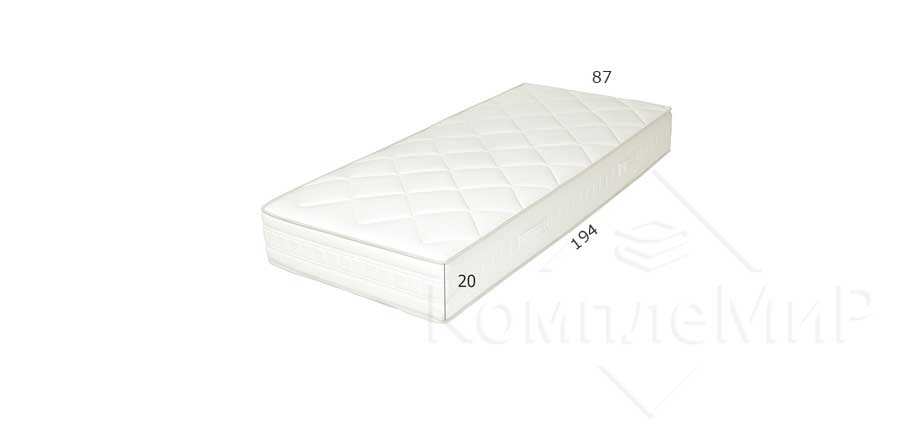
We immediately determine the optimal size of the sheet for our mattress, taking into account the possible shrinkage of the fabric after washing.
For a mattress size of 87x194x20 cm, taking into account the fact that we will sew from calico, the optimal size of the sheet will be 90x200x20 cm.
To calculate the size of the sheet for your mattress, taking into account the possible shrinkage, you can here
P.S.:If the fabric is first washed after the purchase, the size of the sheet will correspond to the size of the mattress. In this case, the shrinkage can be neglected.
Also note that this algorithm implies sewing sheets from one socialnogo cuts of fabric.
For reference:
For the most popular width of canvases 220 cm, one piece of fabric, it is possible to sew sheets, only for the width of the mattress up to 140 cm. For mattresses with a width of more than 140 cm, with such a width of the canvas (220 cm), the sewing algorithm will be different. For more information on cutting sheets with a 220 cm wide elastic band here.
1 Step - determine the size of the roll sheet of fabric required for sewing
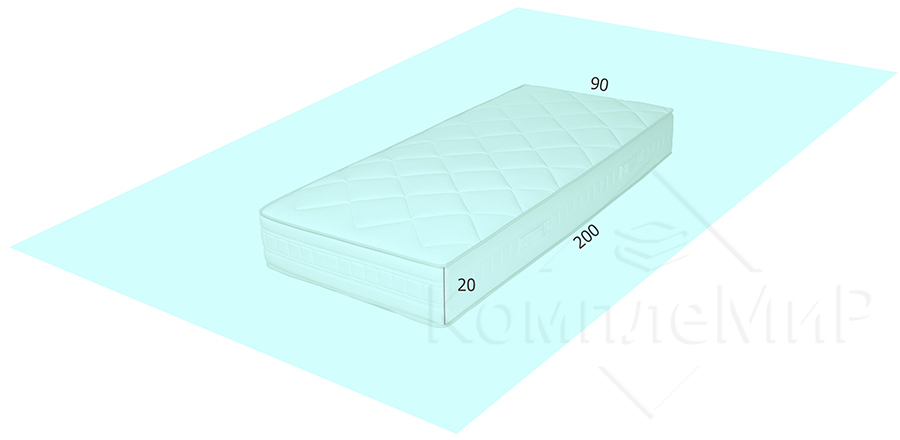
To determine its size, you must first make a sketch of the cutting.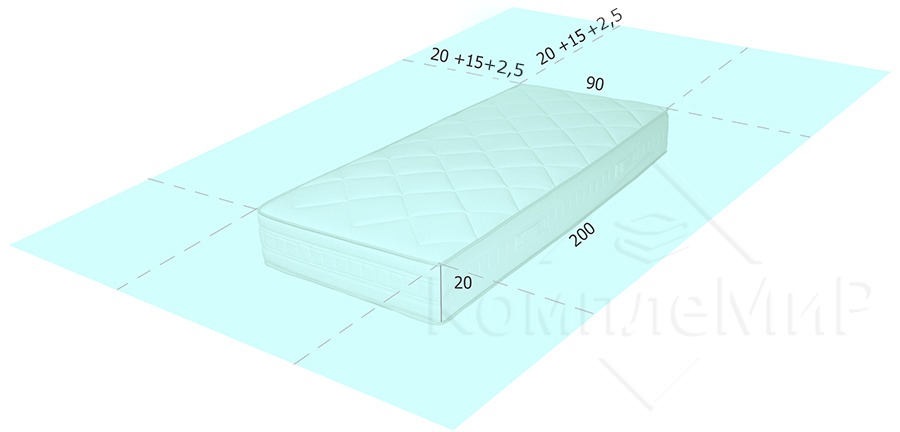
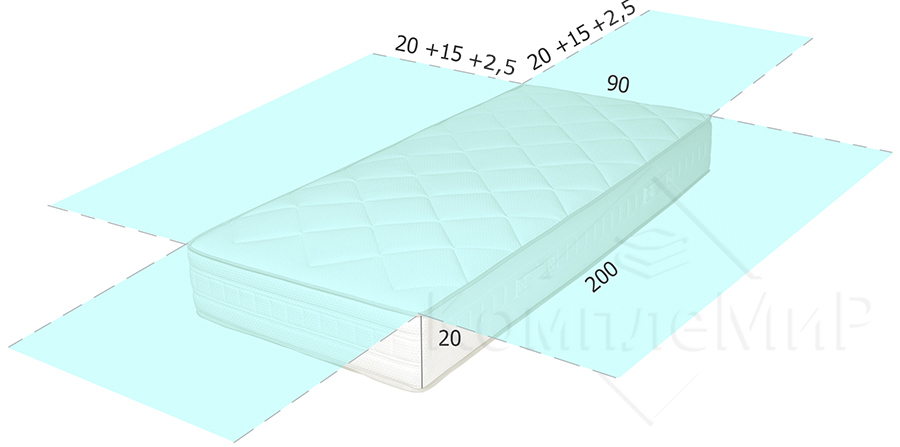
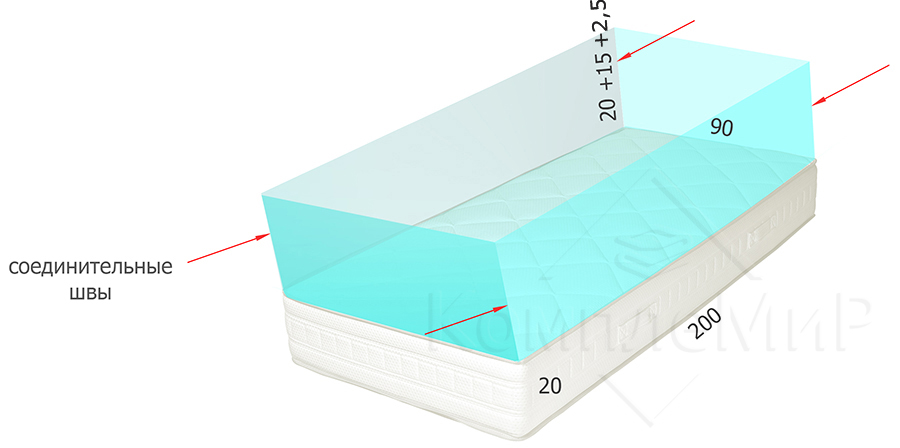
So, from the drawing in general, an idea of how it will be necessary to cut has already been formed. Square cutouts at the corners of the sheet are necessary for the subsequent connection and stitching of the corners of our sheet.
since the height of our mattress 20 cm, then each side is necessary to add that value and add 15 cm of fabric directly under the bend of the sheet under the mattress under bend the ends under very elastic and the edges of the fabric 2.5 cm.
Why 15 cm? This is the average value. It can be considered as a recommended value that is determined from practical experience with the use of sheets of this type.
The recommended size of the bend under the mattress, depending on its size:
- from 60 cm x 120 cm and a smaller area of 10 cm
- from 80 cm x 160 cm to 160 cm x 200 cm & ndash; 15 cm
- from 180 cm x 200 cm and a larger area of 17-20 cm
Why is the bend value greater for larger mattress sizes? Because, with bulky mattresses, the load on its edges is greater and in order for a sheet of this size to sit on it more steadily, bends of this size are made. For smaller sizes, for example, for baby bedding, this is not so relevant.
As a result, the size of our fabric for sewing sheets will be:
- by width (20+15+2,5) +90 +(20+15+2,5) cm = 165 cm
- by length (20+15+2,5) +200 +(20+15+2,5) cm = 275 cm
Step 2 - make the cut according to the calculations made and the sketch
If you need to calculate the amount of fabric cutting, the amount of gum under your mattress, you can use calculator .
Step 3-connect all the corners of the future sheet
We connect all the corners of the sheet and sew them on the inside with a linen or "French" seam using a sewing machine. If there is an overlock, then we will also process them with an overlock.


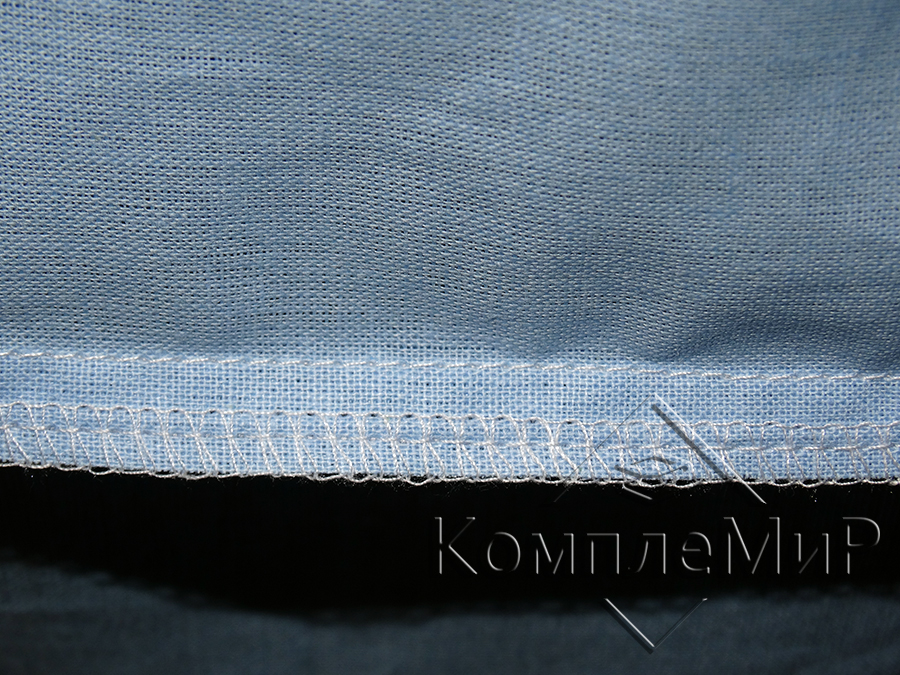
Here is the main frame (box) and ready.
Step 4 & ndash; do scissors on the edges of the fabric serif
We make incisions on the fabric, as in the picture, to determine the places where the elastic band will start and end on each side of the sheet. In our case, the elastic band will not pass around the entire perimeter, but only from two opposite sides with a protrusion along the length of 50 cm from each edge.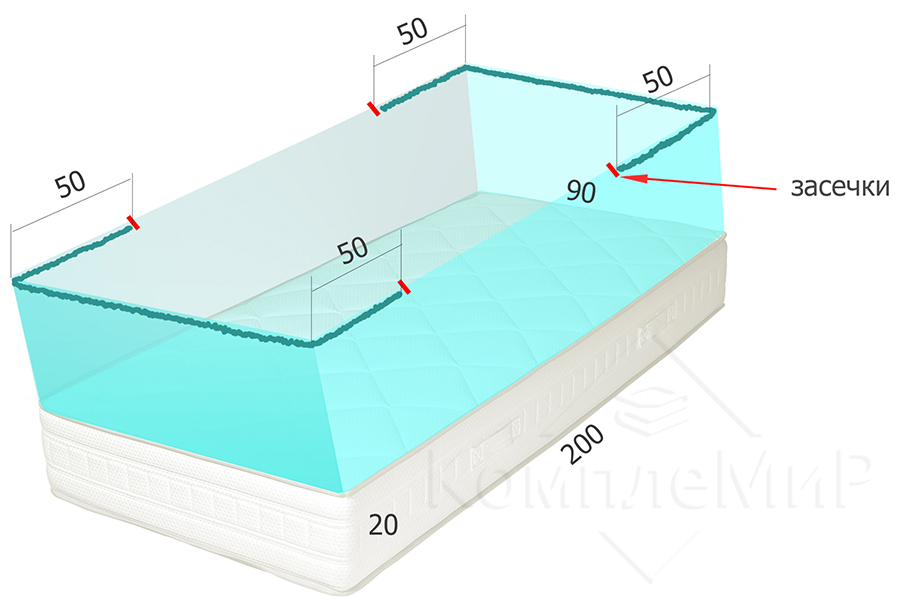
This scheme is the most preferable in terms of the subsequent care of this sheet (ironing, washing, etc.). Try to iron the sheet with an elastic band sewn around the perimeter. And so, there are absolutely no differences in its functionality with the sheet, where the elastic band is sewn over all the areas.
The option with an elastic band around the entire perimeter is more preferable for small-sized mattresses, i.e. for cots.
Step 5-sew the elastic band and put the edges
Before this step, you need to decide – what amount of elastic band is needed for the size of our bed sheet !?
We do the calculation for our option:
(50+90+50)=190 cm of elastic band is necessary for the entire sheet. You need 95 cm on one side and the same amount on the other (190/2).
The calculation formula for any size of bed sheet is the same:
50 cm + mattress width+50 cm = x
Divide x by 2 and get how much gum is needed on each side. If the elastic band is of poor quality, i.e. it is very stretched, then you can use the division coefficient not 2, but 2.5 .

Well, that – with the size of the rubber band decided. We proceed to its sewing.
Sewing the elastic band from the serif of one edge to the serif of the other is carried out by placing it inside the edge of the fabric with its subsequent bend of 2.5 cm (7 mm + 7 mm + 11 mm) and gradually passing the sewing needle to the final serif. In the process of forming the seam, the elastic band must be evenly and consistently tightened, for uniform distribution along the entire path of its passage.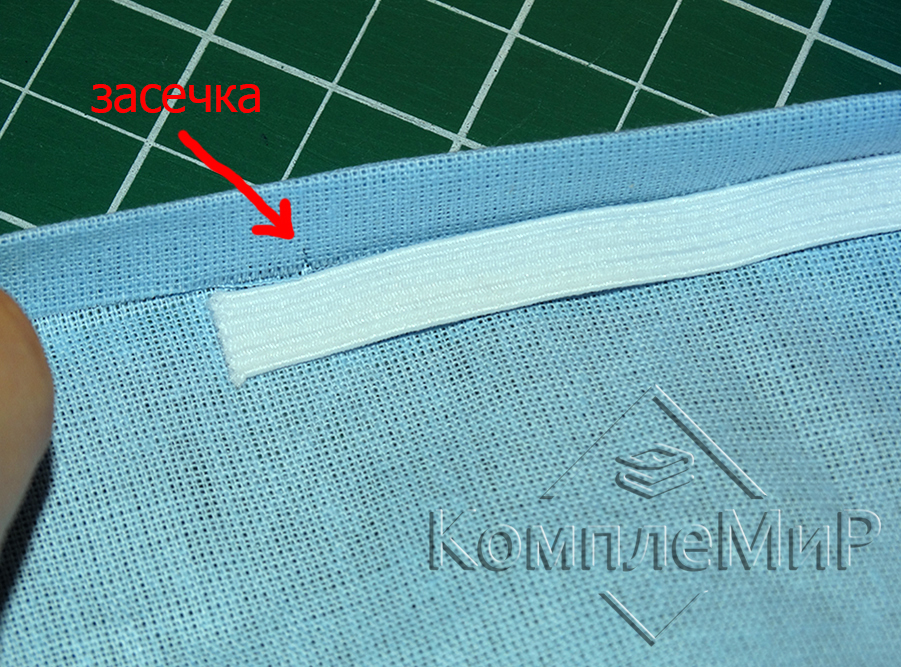

The needle should go without touching the gum itself. That is, the elastic band will not be sewn tightly, which eventually makes it possible to replace it.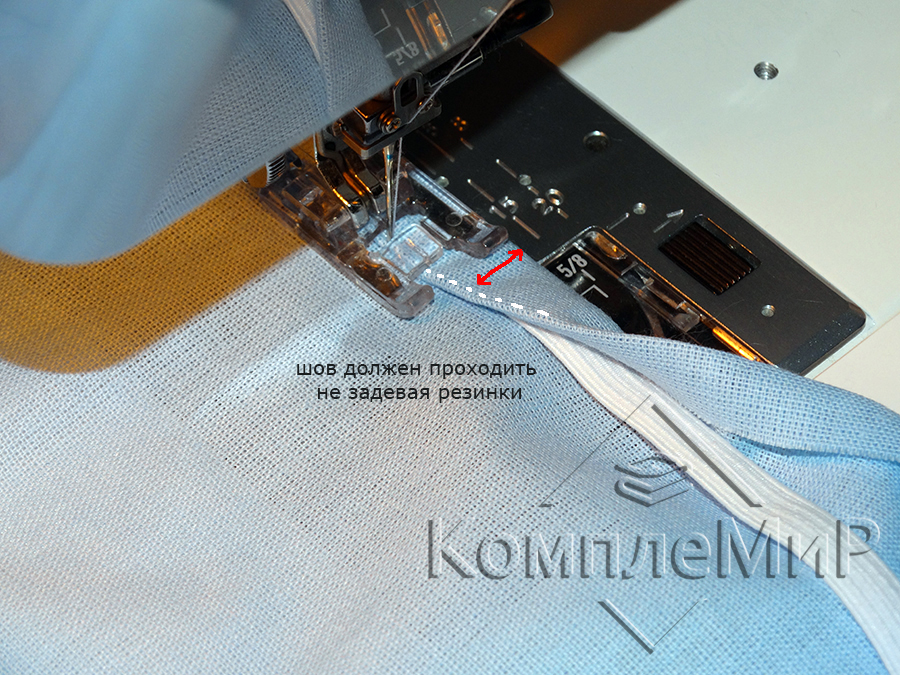
Places of serifs (input and output of the elastic band) lock tightly with a sewing needle, due to which the elastic band will be fixed in the resulting groove.

Similarly, we sew it on the opposite side of our sheet.
The edges of the sheet around the perimeter, where the elastic band will not pass, are usually sewn with a needle, lining the edge of the fabric (2.5 cm) in two bends.
Well, that's it, the sheet is ready.
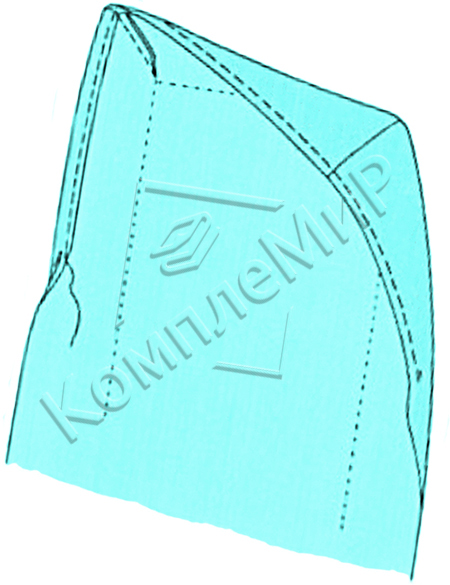
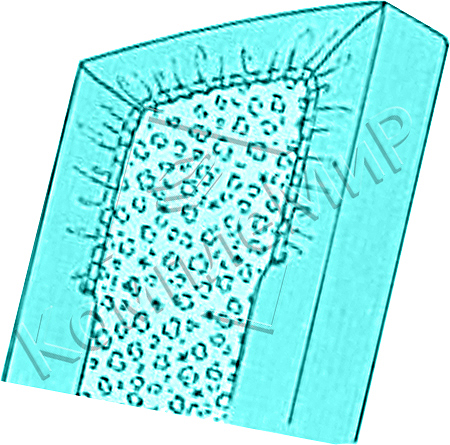
We hope that this article will be useful for someone and will help you sew a sheet on an elastic band yourself.